
Surviving Grief’s Firsts: Three Vulnerable Stories


Everyone talks about the last moment with someone you love. No one prepares you for the Firsts that come after.
This is a collaborative post—three writers standing in different places on the same broken timeline.
Christopher Carazas (🇫🇷🇪🇸🇮🇹🇬🇧) is navigating his first year without Ava.
Lynn J. Broderick is stepping into her first winter without her dad.
Jason MacKenzie, three years out from losing his daughter, is learning how the Firsts still find you long after the world assumes you’re healed.
Wherever you are in your own season of grief, we hope this gives you a place to rest for a moment—and helps you feel a little less alone. We’d love to hear your story, too.
Scroll down to the end for our Substack Live about grief.
Lynn’s Story
I struggled to sit down to write this post. It’s not like I haven’t written about grief before. It’s just that this time felt different.
It’s my first holiday season without my dad, who died in April.
I already had a complicated relationship with the holidays. At some point they stopped feeling magical and started feeling like checkpoints—those blinking markers reminding you how fast everything changes.
Maybe it started the year I noticed my parents aging in real time. My mom’s slipping memory, her thinning hair. My dad’s frame tilting farther toward the ground, his tangents getting longer.
This year, everything feels heightened.
I’m still in the raw, disorienting stretch of loss.
There have already been so many “firsts”—what I’d heard people talk about in that gentle, ominous tone they use when they don’t want to scare you and also don’t want to lie.
I didn’t quite get it at the time. And I probably didn’t want to.
I get it now.
The Firsts aren’t just dates on a calendar. They’re landmines. You never know when you’re going to step on one—or how hard it will detonate.
Firsts don’t care whether you’re ready or not.
And I’m learning I’m not. I’m still trying to catch up emotionally while the calendar marches forward. My shoulders and jaw set in resistance mode.
Sitting beside the body that used to hold him. Handing his urn to my mom. Writing a poem about him. All firsts.
The First Father’s Day came less than two months after he died. It was a blur of tears and numbness.
The First spring/summer—I saw him in the trees. He was the tree whisperer, always digging up saplings and gifting them to us. I began feeling lighter, convinced I had things under control.
First fall, I felt the unraveling. A song about grief knocked me sideways. The falling leaves felt like lead on my heart.
Then came my First Birthday without him.
No “Happy Birthday, Lynn Anne” on November 2nd. Just silence where his voice used to be.
The holiday season….
Last year was more tenuous than joyous.
He’d had a stroke a week or so before Thanksgiving and could no longer care for himself or speak. I don’t remember the details of that day, only visiting him at the nursing home—feeding him because he couldn’t feed himself.
It wasn’t the holiday we were used to, but he was still here.
That’s the part that gets me.
He was still here.
Last Christmas, we visited him in the nursing home. He was asleep, unreachable. Only when I wrapped my arms around him to say good-bye did his eyes flutter, struggling to remain open. We lingered a while, wanting him to know he wasn’t alone.
Even though the holidays always move too fast, this year feels like time’s catapulting straight into disaster while my broken heart drags its feet, wanting no part of it.
I’m bracing for it all with my heart in a vice grip. If skipping the whole season were an option, I’d be the first in line
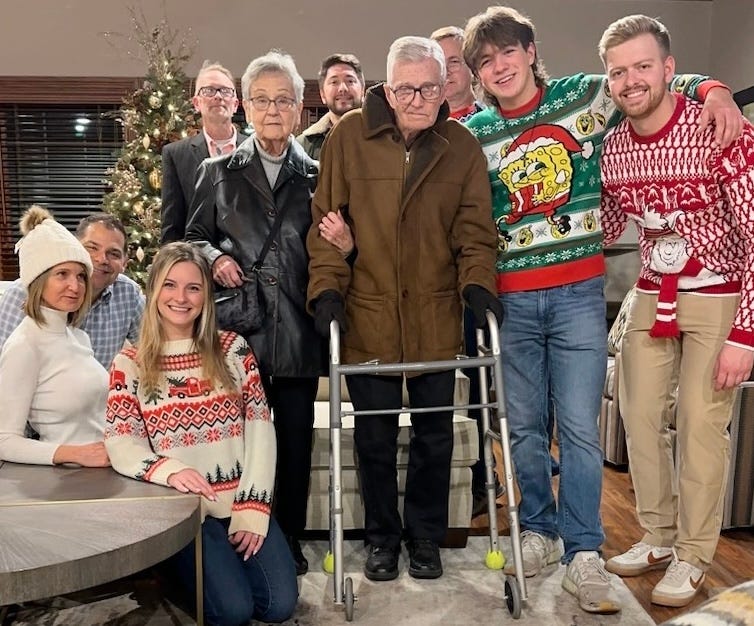
After the holidays, it should be quiet for a while.
His first birthday not on this earth will be March 6th. People call it a “heavenly birthday.” I’m spiritual not religious and can’t say I know what happens after this life.
I’d like to believe he’s at his favorite lake. I’d like to believe I’ll see him again.
A few things have happened to make me wonder.
After he died, I was playing Scrabble with my son and husband. In the middle of the game, I glanced down—my tiles read: LENRNRD. Nearly Leonard, his full name. He went by Len. I didn’t consciously arrange them that way. It felt like a wink.
There have been nights where I’ve felt someone sit on my bed, a hand resting lightly on my side, just as I’m drifting off. A dream, maybe. But it sure feels real.
In one vivid dream recently, he told me he could only “be here” if I believed he was here. His presence was almost touchable.
These little mystical nudges—real or imagined—have comforted me. Maybe, just maybe, he’s watching over me. I want it to be true and, dammit, all I have to do is believe.
Facing the Firsts.
This year, I’ll try to switch things up: Thanksgiving with friends, The Nutcracker as a festive distraction, Christmas in California with my Navy son. Maybe I’ll invent some new traditions. Even have some fun. And I’ll also try to honor the parts of me still figuring out how to let grief do its thing. To feel the feelings instead of trying to conquer or control them.
My Firsts are complicated by the possibility of Lasts for my mom. Over nine months ago, doctors gave her “months, maybe weeks,” yet she’s still here somehow, living mostly independently.
So I’m not just grieving my dad, I’m also bracing for the possibility of losing her too.
What I do know: I was doing okay for a while. Until I wasn’t. I will be okay again. And I need to be kind to myself. Give myself some grace.
The good news about Firsts.
There’s only one set.
Make that two—the Firsts our missing loved one shared with us while they were alive.
My dad was here to witness sixty-one years of my life, including the first moment I held my son.
And for that, I will be forever grateful.
The Firsts are a lot. But they’re also proof that we loved deeply. And that’s a gift.
What’s helped me move through.
Here are just a few things that have provided comfort:
Tara Brach’s talk Fires of Loss. In it, she describes “the gift of timeless love that arises as we make peace with the reality of this living, dying world.” She has other talks about grief, loss, and impermanence that have also helped.
The Beauty of What Remains: How Our Greatest Fear Becomes Our Greatest Gift. Written after losing his own father, Rabbi Steve Leder brings a mix of wisdom, compassion, and unexpected humor to the topic of grief.
Anderson Cooper’s podcast, all there is. Vulnerable and surprisingly comforting conversations about grief, love and everything left behind.
I’m still learning how to live in a world my dad’s no longer in. But I’m also learning he may not be as far away as I thought.
Christopher’s Story
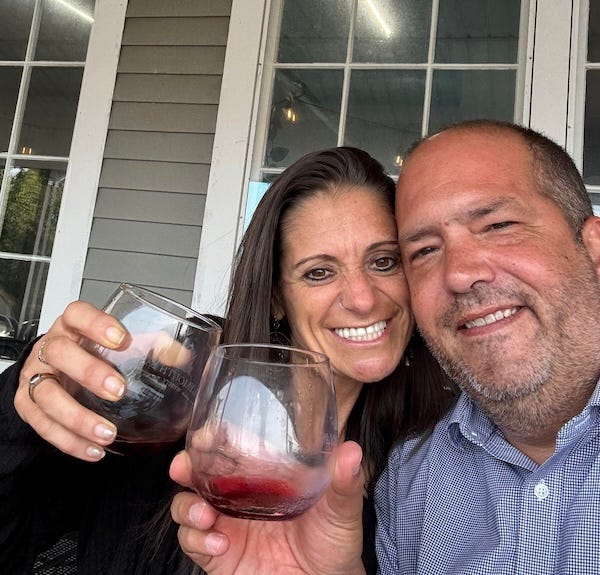
The first holiday without her didn’t arrive. It hunted.
The world kept setting tables, hanging lights, pretending nothing had shifted.
I stood in all that brightness learning how to breathe in a season that hadn’t noticed she was gone.
Time doesn’t pause for the dead or the ones who loved them.
It moves like a river that refuses to change its course.
The firsts rose like sentinels I had no choice but to pass.
Fourth of July. Memorial Day.
A birthday candle glowing over an empty chair.
They slipped in quietly: the smell of her shampoo in cold air, a song ambushing me in a grocery aisle, Shadow waiting at the door as if footsteps still belonged to this world.
Ava entered my life like someone sent to pull me out of the wreckage.
After the hospital. After the silence. After I had begun living inside the outline of my own ghost.
She looked at me and didn’t turn away.
She saw the ruins and named them worthy.
Her laugh held the sound of someone who knew the fire from the inside.
With her, life shifted from endurance into a fragile pulse.
We met in June 2024, just before fireworks traced their patterns across the sky.
That summer became a single breath of open windows, soft light, and laughter that spilled into every corner.
A road trip to Vermont.
Karaoke nights that dissolved into joy.
Wineries. Haunted Six Flags.
Saturdays that felt sacred because she moved inside them.
She left notes everywhere.
Small pieces of her voice folded into paper.
“You are stronger than you think.”
“I love you.”
“Do not forget how far you have come.”
I still keep them.
They shine like lamps in the dim corners of the apartment.
By 2025 we had plans.
Eight laps in a Ferrari.
Summer hikes.
Her pretending not to care while I chased stories about the Bridgewater Triangle.
We weren’t chasing milestones.
We were chasing the ordinary, and the ordinary felt holy.
Then February came.
She traveled to New York to accept an award.
She called that night, bright and alive.
When she returned she was tired, yet insisted we go out for St. Patrick’s Day.
She laughed through the fatigue.
She glowed even while her body dimmed.
A week later she skipped karaoke.
The next morning the world cracked.
She was in the ICU.
Mono. Double pneumonia.
A ventilator replacing her breath.
I wrote silently at home.
Chapters she would never read.
I wanted her to know what she was saving.
I wanted her to know she rebuilt me.
But the body has limits, even when the soul refuses to yield.
Three weeks later she was gone.
April took her.
Spring bloomed anyway, indifferent and bright.
Now the holidays have teeth.
They don’t sparkle. They bite.
Every aisle feels wired.
Every invitation feels like a dare.
At Stop and Shop the scent of turkey lingers in the air.
I stare at the cranberry cans she tapped twice.
I buy one.
It feels like lighting a candle in public.
Thanksgiving was meant to be hers this year.
Last year I didn’t stay long.
I was split between my family’s fear and her quiet hope.
No one was wrong, yet everyone lost.
I told her I would make it right.
I meant it.
This year I was going to stay.
Now there is only a ghost place setting I can’t bring myself to fill.
Christmas feels like it’ll be a lesson I never learned.
Last year she sent pictures of hideous ornaments.
She made chaos beautiful.
This year the ornament box stays closed.
Lights feel sharp.
Joy feels foreign.
Sometimes I picture the Christmas we should’ve had: neon wrapping, burned cookies, Shadow stealing dessert, a dance in the kitchen to a song neither of us liked.
Now those songs echo through stores like ghosts.
Every carol feels cruel.
Every light too bright.
Grief turns joy into glare.
Maybe holidays exist to convince us that time loops instead of breaks.
Decorating ruins is how we pretend the fracture softens.
Maybe denial and faith share a doorway.
Maybe grief is the scripture we inherit without asking.
Her birthday arrived in October.
She would have turned 42.
She hated birthdays.
Last year we planned something loud anyway.
This year grief sat beside me and whispered.
Grief does not keep score.
It only asks if you loved them.
If the answer is yes, it stays.
Some days I wonder whether a single year gives me the right to grieve this deeply.
She had parents.
Friends who loved her long before I did.
But love isn’t measured in years.
It’s measured in recognition — that instant someone sees you and refuses to turn away.
She did that for me.
That must matter.
My birthday comes in December.
Last year she brought balloons and told me being alive was reason enough to celebrate.
This year maybe I will light a candle.
Maybe buy a single balloon.
Maybe nothing.
Sometimes survival is the only tradition that remains.
The holidays feel unsteady.
Part of me wants to honor her with joy.
Part of me wants the world to stop celebrating until she returns.
Grief creates a rebel and a coward inside the same heart.
Family asks if I’ll join them.
I say yes because it’s easier than explaining that I’m already sitting beside an empty seat no one else can see.
Everything has changed temperature.
Coffee tastes like static.
Laughter sounds too loud.
Light feels too quiet.
And beneath it all, something flickers.
A thin light refusing to die.
Maybe grief is the light that remains after the fire leaves.
It doesn’t heal. It reveals.
It shows what stands when everything else has fallen.
Grief becomes architecture, hidden beams holding what is left.
Living isn’t progress.
It is carrying.
Memory. Absence.
Proof that love lived here and still has nowhere else to go.
She’s still here.
In the tide.
In Shadow’s tilt of the head when I say her name.
In the thin line of light under the door when I can’t sleep.
Maybe the miracle isn’t that love survives death.
Maybe it is that we choose it knowing it will end.
The firsts still hurt.
They always will.
Tonight I will leave one light on.
Not because she’s coming home.
Because love keeps looking for a place to land.
Jason’s Story
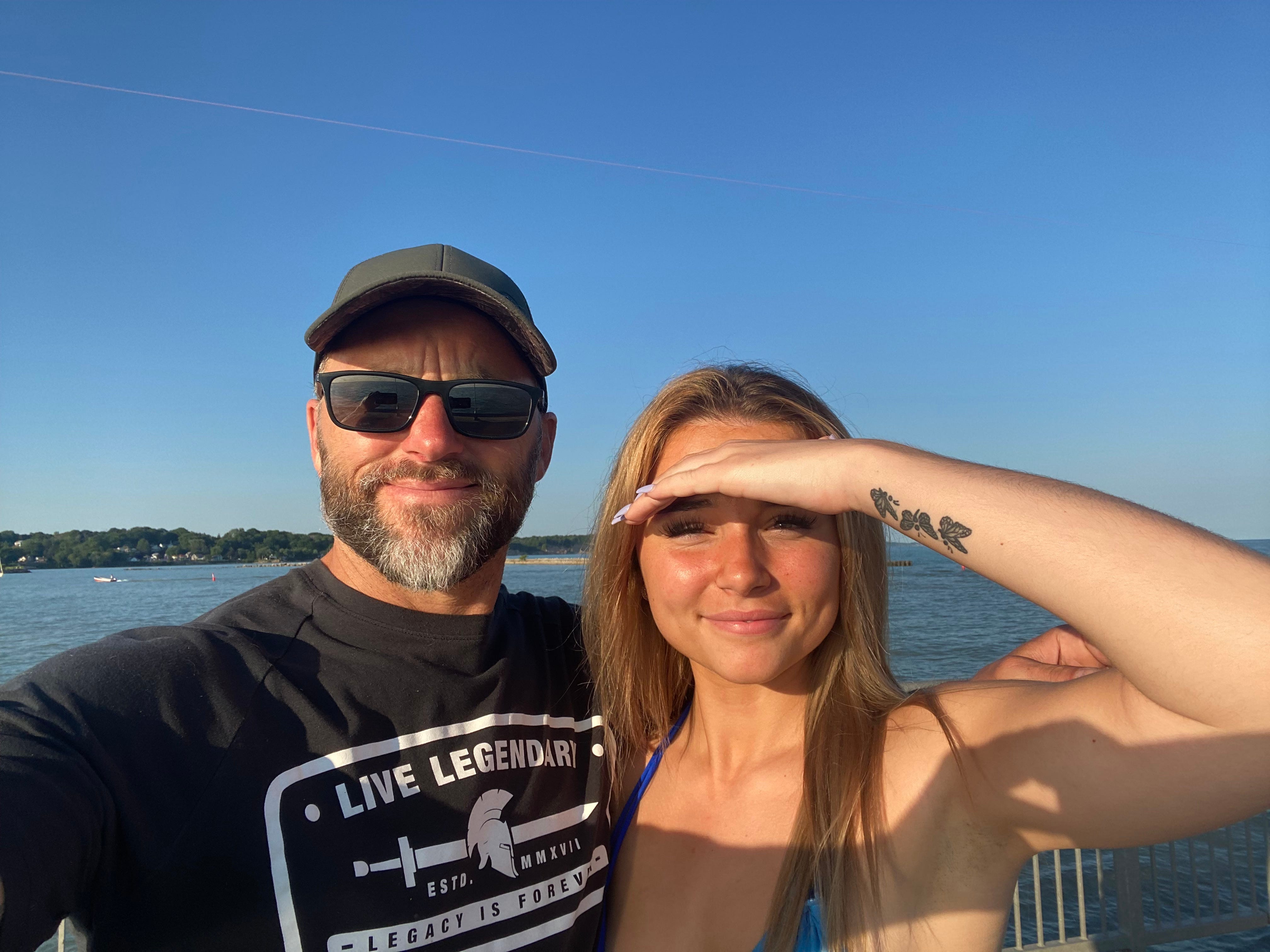
It’s been almost three years since losing my daughter, Chloe, at nineteen. Some days it still feels impossibly recent. Other days I catch myself wondering if she ever really existed. Both feel like betrayals in their own way. That’s one of the “firsts” no one talks about. The first time grief makes you question your own memory, your own reality and your own sanity.
Our family is heading into another stretch of heavy dates. Chloe would have turned twenty-two this December 16. Nine days later comes Christmas. Six weeks after that is the anniversary of her death. And six weeks after that is the anniversary of my first wife Cindy’s suicide.
In year three, these aren’t the first milestones without her, but somehow every milestone still feels like a first.
Every year, I’m a little older. A little softer in some places, more hardened in others. Every year, my grief evolves, and I have to learn how to navigate this version of it for the very first time.
Loss doesn’t just take the person. It rewires your relationship with time. The calendar becomes a map of landmines you start anticipating months ahead. You picture the hell you’re about to walk through. You rehearse the crash before it happens, as if bracing hard enough might soften the impact.
But here’s another unexpected first: sometimes the day comes, and nothing happens.
“Chloe would have been twenty-one today and I feel almost nothing. What is wrong with me? Am I suppressing this? Have I moved on without wanting to? Is this yet another moral failing?”
That feeling didn’t just confuse me the first two years. It pissed me off. I’d spent weeks dreading the day, only to feel… ordinary. As if grief owed me the pain I’d been preparing for.
It took time to understand what was really happening. The flatness wasn’t absence, it was utter depletion. I’d spent so long anticipating the heartbreak that by the time the date arrived, I’d already lived it ten times over.
I had, in a very real way, run out of dread.
For a long time, I thought that meant I was grieving wrong.
But now I see it differently. Dread isn’t the opposite of love. It’s what love can turn into when you’re terrified to feel it directly. It’s your mind trying to shield you from being overcome by emotions you’re not sure you can survive.
And for a lot of men, that tracks. We’re taught to stay in control no matter what. Anticipating pain feels safer than letting it sucker punch us. But that control comes at a cost. It’s like living behind dirty bulletproof glass. You can see the outlines of life, connection, joy, but you can’t quite feel them. The danger stays out, but so does everything else.
This year, in this season of third-year firsts, I’m trying something different.
When dread shows up, I’m not going to fight it or feed it. I’ll notice it and let it move through. And when I inevitably slip behind the glass, I’ll step back out again. And again. As many times as I need to.
I’m going to talk about it with the people who love me, because resilience is relational. Every time I’ve tried to navigate grief as an army of one, it’s failed me. Healing happens in connection, not in isolation.
If the past few years have taught me anything, it’s that grief hides in the ways we protect ourselves, in the stories we tell about what these milestone days should mean. It hides in plain sight.
So this year, I’m not trying to survive the dates circled on the calendar. I’m trying to live them. To honour whatever shows up. To let the days be what they are.
I’ve spent fifteen years bracing for impact. This time, I want my first instinct to be different.
This time, I want to live the days as they come, open, honest, and with my shield finally set down.
Watch our recording about grief’s firsts.
We’d love to hear your story.
Are you still bracing for your Firsts? Have you made it through and found some footing again? What’s helped?
Write your own Substack post about Firsts (or even third Firsts) or tell us your story right here in the comments section.
At some point, we’ll be highlighting a selection of reader comments and posts (with links back to your originals) in a post in the new year. We’ll may even choose one of you to join Jason on Substack Live to talk about your Firsts.
If you write one be sure to tag us—Lynn J. Broderick, Jason MacKenzie and Christopher Carazas (🇫🇷🇪🇸🇮🇹🇬🇧) —so we can find your story. Feel free to share one you’ve already published, too!
 | A guest post by
|
 | A guest post by
|